
AI Shopping Is Here: What Finnish Merchants Can Do Now

Your customers may already be asking AI what to buy. Whether they find your products depends on what those systems can see.
AI-assisted shopping is growing fastest in the US, but the pattern is spreading. Consumers describe what they need to ChatGPT, Gemini, or Perplexity, and the AI assistant researches, compares, and shortlists before the shopper visits any store. Personal agents like Meta’s Muse and Instinct go further: they browse stores, fill carts, and complete purchases on a shopper’s behalf. For Finnish merchants selling cross-border, some of those shoppers are already yours. For those focused on the domestic market, the same shift is coming.
From search to AI shopping
Think of online shopping in three stages:
- Human-led. The shopper searches, reads product pages, compares, and decides.
- AI-assisted. The shopper describes a need to an AI assistant, which does the research and shortlisting.
- AI-led. A personal agent browses, compares, and handles the full transaction on the shopper’s behalf. Meta’s Muse already does this in the US.
Most merchants are at stage one or two, but the shift is accelerating. Adobe found that AI-referred traffic to US retail sites grew over 1,200% between July 2024 and February 2026. ChatGPT now shows product cards with buy buttons. Google is weaving shopping results into AI Mode. Perplexity lets users buy directly from the answer. These are not experiments in a lab. The major platforms are building commerce into their AI products, and traffic is following.
Whether you sell domestically or cross-border, the AI may have already made its recommendation before the shopper reaches your product page.
We have seen this before. When mobile overtook desktop, nobody treated it as just another traffic source for long. It changed how sites were built, how products were photographed, how checkout flows worked. ”Mobile-ready” went from nice-to-have to table stakes. ”Agent-ready” is heading in the same direction.
Two paths: how AI assistants find your products
Your product information reaches an AI assistant through two main routes.
The crawl path. The AI system reads the open web: your product pages, reviews, third-party articles, and community discussions. It has to find each page, access it, and figure out which information belongs to which product.
The feed path. You send structured product records to the AI system through commerce platform catalogs, Google Merchant Center, direct merchant feeds, or commerce APIs. Instead of piecing together facts from page text, the system gets defined fields: identifiers, price, availability, variants, images, and merchant information.
When a shopper’s intent is broad (”what are good Finnish outdoor brands?”), the AI pulls from editorial content and brand pages: the crawl path. When the intent is commercial (”wool base layer, under €150, ships to Germany”), the system wants a buyable product card with price and availability. For that, it reaches for product feeds first.
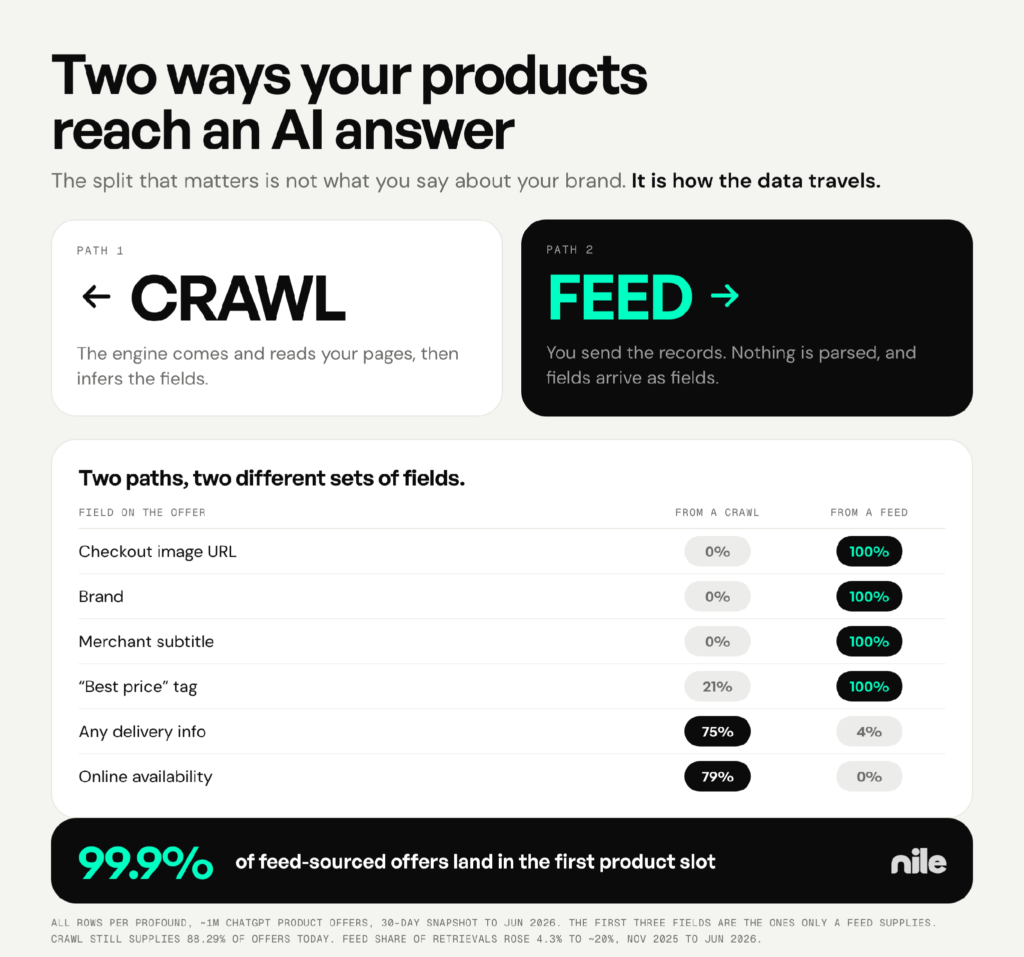
Two ways your products reach an AI answer: crawl path vs feed path comparison with Profound data
Four gates from mention to purchase
These two paths connect to commercial outcomes through four gates:
- Mentioned. A product comes up in an AI response. Depends on editorial content from the crawl path: guides, articles, brand coverage.
- Listed. A product appears with enough detail to evaluate. Feeds give the system the structured fields it needs for a product card.
- Chosen. A product is selected over alternatives. Depends on Product Context: who the product is for, when it fits, why it should be picked.
- Bought. The transaction completes. Depends on price, inventory, checkout availability, and fulfillment.
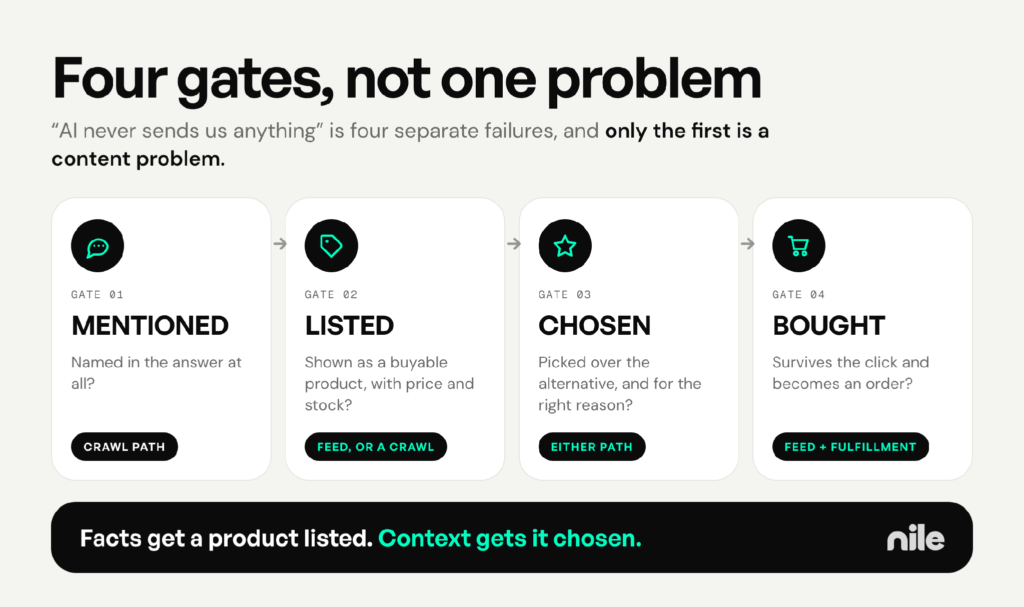
Four gates from Mentioned to Bought, each gate depends on different information
GEO (Generative Engine Optimization) and AEO (Answer Engine Optimization) help with the first gate: getting mentioned. They do not, by themselves, get a product listed with structured fields or chosen over alternatives. That requires structured feeds and Product Context, which the next sections cover.
Making your site AI-readable
You do not need to wait for native AI checkout to start. In another post on this site, Samuli Hokkanen shared a detailed technical readiness checklist in Finnish. The essentials: make sure AI crawlers are not blocked in your robots.txt, verify that product titles, prices, and availability appear in the raw HTML (not only after JavaScript runs), keep your sitemap and structured data (JSON-LD) consistent with what is on the page, and ensure price and availability match across your pages, markup, and feeds.
Technical accessibility helps an AI system find and read a product. It still does not tell the system whether that product is the right recommendation.
Where the sale is decided: feeds and product context
Structured product data already matters for AI shopping. Profound analyzed roughly 548 million product offers over eight months and found that products from structured feeds were far more likely to land in the first position in AI shopping results than products the system had to crawl from web pages.
But a feed alone does not solve the recommendation problem. Catalog data tells an AI system what a product is. Product Context helps it decide who the product is for, when it fits, and why it should be picked over an alternative.
Catalog data includes identifiers, category, price, materials, sizes, images, and fulfillment information. This gets a product matched against hard constraints like price range or size.
Product Context includes the intended customer and use case, the situation being solved, objective comparison points, trade-offs, evidence behind claims, limitations, and market-specific fit.
Facts get a product listed. Context gets it chosen.
Take a Finnish outdoor brand selling a wool base layer. The catalog tells an AI assistant it is wool, costs €140, and comes in several sizes. But a shopper might ask: ”I need one warm base layer for a week of hiking in Lapland in October, under €150, that I can wash in a cabin sink and have dry by morning.” A useful recommendation requires more: warmth relative to weight, how it performs when damp, whether it works alone or as part of a layering system, drying time, care requirements, wool-sensitivity limitations, and how it fits under a shell. Translation alone cannot create this information.
And it is not just one question. The same base layer can match many buying intents: a gift for someone who runs cold, a packable layer for travel, a sensitive-skin alternative to synthetics, a base that works under a shell for wet-weather hiking. Each buyer needs different information to say yes. Product Context, delivered through feeds, can tell a different story for each intent.
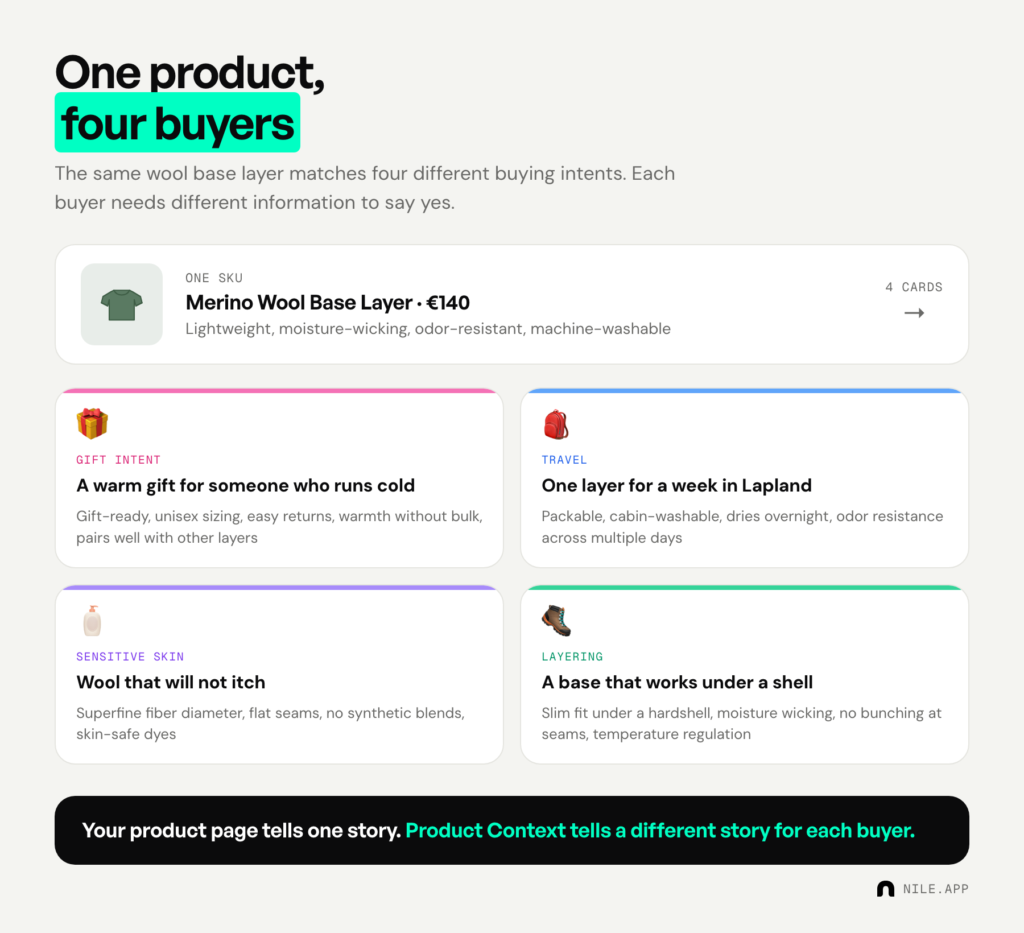
One product, four buyers: the same wool base layer matches four different buying intents, each needing different context
Most of this information already exists in customer reviews, support conversations, specification sheets, return reasons, and the product team’s own knowledge. It is rarely pulled together as structured Product Context.
Two ways to start
Option 1: start manually with priority products. Pick a manageable group: strategically important products that are frequently compared or misunderstood. Write realistic shopping questions, check whether the product appears, gather Product Context from reviews and product knowledge, update the relevant fields, and test again.
Option 2: prepare the full catalog with automation. A Shopify merchant using a product context platform such as Nile can start at catalog scale: connect the store, analyze every product, identify where Product Context is missing, and keep it current as products and markets change. Think of it like the shift from manual to programmatic media buying: each product can match dozens of different shopping questions, and writing context for each intent by hand does not scale. A programmatic approach detects the intents, generates the matching context, and refines based on what leads to purchases. The more intents you cover well, the more conversations your products show up in.
Going catalog-wide matters because the perfect answer to a specific shopping question may not be your bestseller. A niche product could be exactly what that shopper needs.
The first-mover window is still open
When native AI checkout reaches Finland, or the markets you sell to, depends on platforms, payments, regulation, and market-by-market rollout. No merchant controls that timetable.
What you can control is whether your products are accessible, accurate, and understandable when an AI assistant is asked what someone should buy. This work pays off before agentic checkout arrives, because it also improves your current product pages, search results, and shopping feeds.
When the transaction layer does reach your market, the merchants best positioned to benefit will be the ones whose products AI systems can already understand, compare, and recommend with confidence.
Where to start:
For a technical readiness checklist, see Samuli Hokkanen’s post on agentic commerce preparation (in Finnish).
To begin manually, apply the process above to a group of priority products. To prepare Product Context across your entire Shopify catalog, connect your store to Nile.

