
Finnish e-commerce is eager to grow. Almost half of Finnish online retailers expect domestic sales to grow by more than 10% over the next year. At the same time, AI is changing how people shop. Shoppers ask AI assistants which product to buy, retailers are piloting AI agents that take orders in a chat, and new AI training programs are popping up to help merchants keep pace. Put those trends together, and you get a tempting conclusion that going international has never been easier.
In many ways, that’s true. A few years ago, entering a new market meant spending a lot of time on translation, new product copy, and a website rebuilt for each country. Today, AI can translate your store overnight, adapt your content for ten markets, and help shoppers abroad find you through the AI tools they already use to search.
But there’s a catch. When everyone can look international, looking international stops being an advantage. It becomes the bare minimum. So, what does it actually take to be local?
Know where to go and localize what decides the sale
When merchants ask me which market to go for next, I usually turn the question around. Where are people already buying from you? It’s tempting to aim for Germany because it’s big, or for whichever market other merchants are talking about right now. But your own analytics usually have a better answer. Say you get a few hundred visitors a week from Sweden or Estonia, and orders keep trickling in from there even though you’ve never run a campaign in either country. Yet only a handful of those visits end in a purchase.
That gap is worth taking seriously. The interest is clearly there, so something on the way to the checkout is stopping people. Often it’s a small thing, like a payment method they’ve never seen before. And it’s usually not the translation. Most stores get that part right these days. It’s the details around it. Are prices shown with VAT included, the way locals are used to? Can customers pick up their parcel where they normally do? Is it easy to send something back?
Finnish shoppers are a good example. We order from abroad all the time. 8 in 10 of us did last year. But we also have our habits. We prefer parcel lockers more than anyone else in the Nordics, and if shipping costs too much, we simply close the tab. According to PostNord’s E-commerce in Finland report, that’s the most common reason Finns abandon a checkout. So, a foreign store that only offers pricey home delivery has lost a lot of us before we’ve even seen the payment options. Shoppers in Germany or the Netherlands have habits like this too. It pays to find out what they are before you launch.
How we pay in Finland and why it doesn’t travel
We hardly think about it. At the checkout, you pick your bank, whether it’s OP, Nordea, or S-Pankki, confirm in the app, and that’s it. Or you tap MobilePay to be even faster. Younger shoppers increasingly reach for their debit card, and when you want a bit of flexibility, you pay later. Pay later accounts for 19% of e-commerce value in Finland, more than twice the European level of 9% and almost five times the global average of 4%, according to Worldpay’s Global Payments Report 2026. Across the Nordics, pay later is the norm, with Sweden at 25% and Norway at 19%.
It all feels so natural that it’s easy to forget these are local habits, not universal ones. Step outside Finland, and the habit goes by a different name.
Here are some examples, all of which merchants can offer through Qliro this fall:
- Across Germany, France and Belgium, Wero already reaches 80% of banked consumers.
- In the Netherlands, about 7 in 10 online purchases are paid with iDEAL, directly from the shopper’s banking app. iDEAL is also gradually merging into Wero, making it a gateway to several markets at once.
- In Belgium, Bancontact accounts for over 94% of all debit cards and has been part of everyday life since the 1980s.
- In Poland, BLIK plays much the same role MobilePay does for us, with almost 22 million active users. It’s the quick, familiar way to pay with your phone.
- In Austria, EPS is one of the most trusted ways to pay online. It lets shoppers pay by bank transfer straight from their own bank, much like our bank button.
And the list goes on. For these shoppers, these payment methods aren’t one option among many. They are simply how you pay online. Leave them out, and many carts stay exactly where they are, just as a Finnish shopper would hesitate at a checkout with no bank payment or MobilePay in sight.
It works both ways. A European brand entering Finland without MobilePay would hit the same wall. Local habits are not a detail to fix after launch. They are the launch.
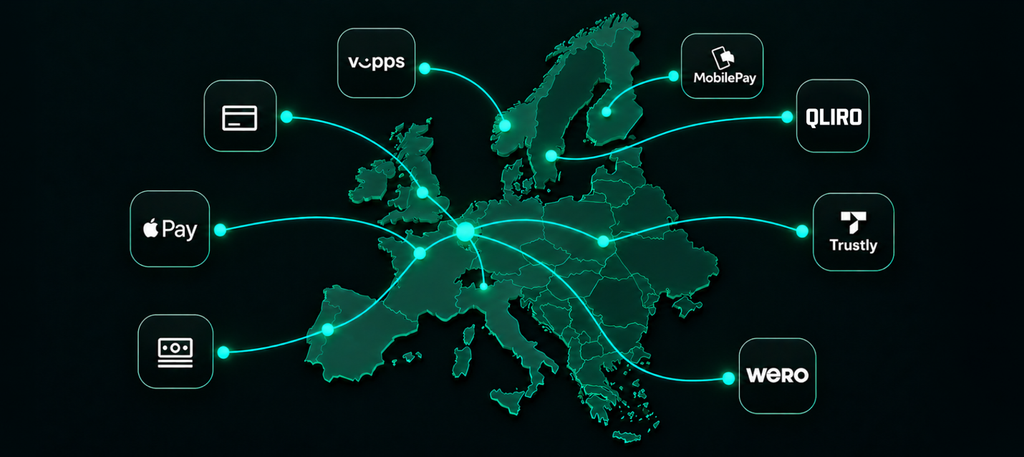
New market, same checkout
At Qliro, we have always seen ourselves as more than a payment provider. Our job is to help merchants grow, and today that also means helping them grow beyond the Nordics. This autumn, we’ve been steadily adding the local payment methods that matter most in each market, one launch at a time.
The idea is simple. New markets, same checkout. Merchants keep one checkout, one agreement, and one payout, and we activate the payment methods their new customers already know and trust. Since our checkout is modular, it connects with the delivery partners and e-commerce platforms merchants already use, so local delivery options can sit right next to local payment methods.
AI makes much of this faster. The smartest merchants won’t stop at translation. They’ll use AI to spot where demand is already growing, understand how shoppers in each market behave, and make sure their products are easy to find and compare, for people and AI assistants alike. But remember, it still takes local knowledge and a partner who has done it before. AI speeds things up. The right partner makes sure you’re heading in the right direction.
Because in the end, the merchants who win abroad won’t be the ones who look the most global. They’ll be the ones who feel the most local, all the way to the checkout.
Before you pick your next market, ask yourself the following:
- Where are international customers already finding you, and where does your checkout convert worst?
- How do customers in that market prefer to pay, and can you offer it from day one?
- Do prices, delivery and returns feel normal in local terms, with local taxes, familiar delivery options and clear return terms?
- Does the whole journey speak their language, from confirmation emails to customer service, and is your product information clear enough for the AI tools shoppers use to compare?
- Can you add the next market without a new integration, agreement, and payout every time?
Planning your next market? Reach out and let us help you, or read more about global expansion through Qliro here.